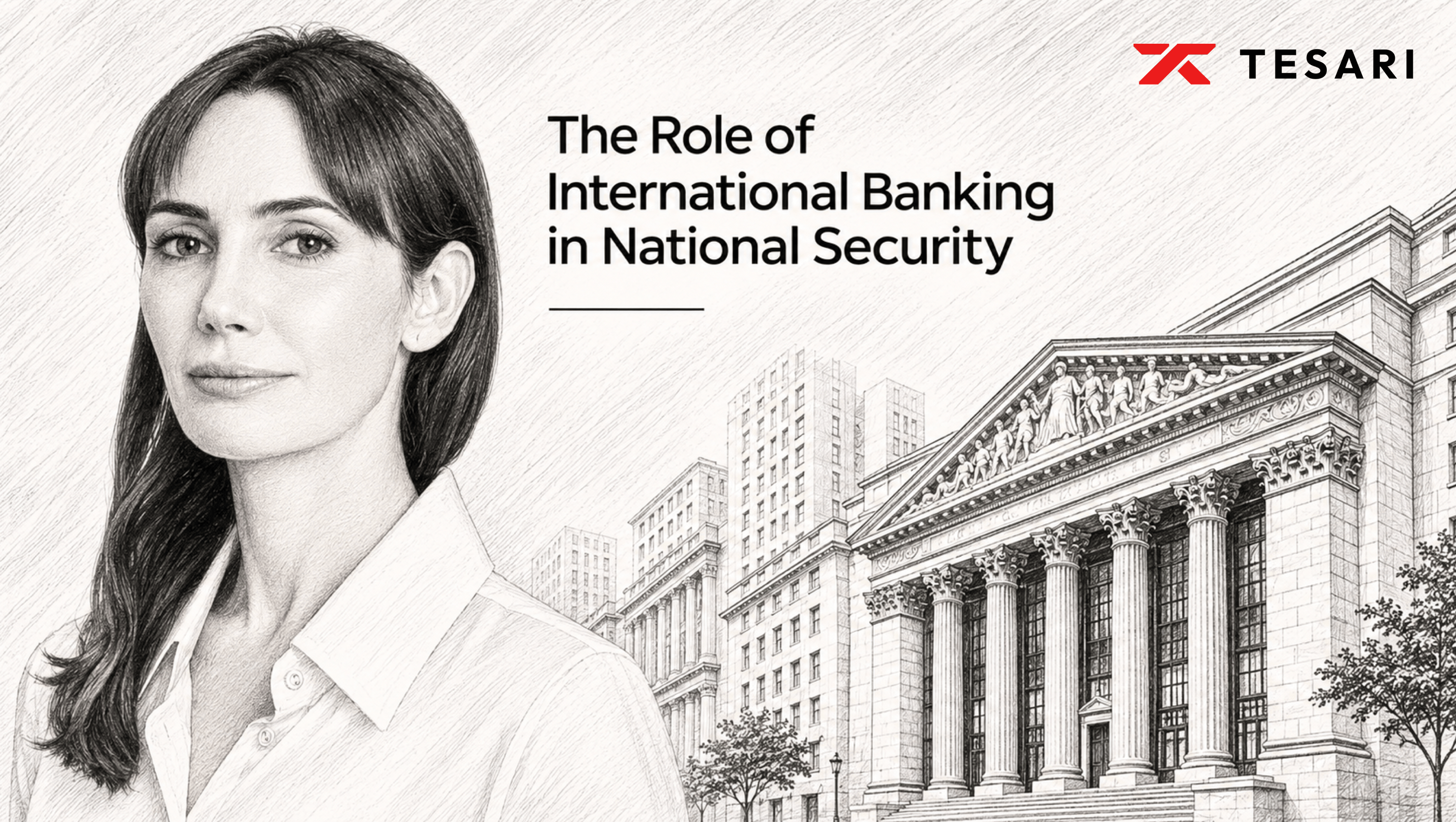
The Role of International Banking in National Security

November 9, 2026

•

Karanai Ravenscroft

•

Tesari National Security & Strategic Threat Council

•

Co-founder and COO, Sovereign Bank International

What is the role of international banking in national security and intelligence?

 This is what governance and measured controls must both ask, and answer.


The question is not academic. International banking is not adjacent to national security; it is squarely within the national security infrastructure itself. Banks hold the ledger of global trade, correspondent flows, sanctions integrity, and proliferation finance. Every one of those is a national security line of visibility that lives inside our institutions.


Compliance can execute, but only governance can ask. The question is a governance question because it decides a bank's purpose, what it will refuse, what it will protect, what it will seek to understand, and what it will see.


A second dimension deserves equal weight. Where legitimate international banking does not reach, illicit networks become the only available infrastructure. Extending defensible banking into underbanked regions and developing nations is itself a national security contribution. 


It denies illicit actors their monopoly on access. It builds economic foundations that are structurally harder to corrupt than the alternatives that fill the vacuum of economic demand. This is a dimension of security policy the industry has not fully articulated. 


An example from my experience illuminates the underbanked transactor who cannot access the formal settlement system safely and efficiently. These transactors include developing-nation populations whose legitimate activity is forced into informal “currencies of exchange” and “underground economies” with less transparent channels of transaction. This is particularly common where currency controls are in place, and where cash transactions are the standard of exchange.


Necessity drives a path that would otherwise be avoided when legitimate settlement rails, governed institutions, and currency access support viable retail economics.

Consider Brazil, Guyana, and other emerging markets. In Brazil, low-entry fintech licenses established from foreign jurisdictions, unregulated FX exchanges, and VASPs have moved in to serve the underbanked where governed institutions do not reach. Having identified this risk, Guyana has prohibited VASP activity domestically. Even so, its own FIU, in a 2023 Risk Assessment on Virtual Assets and VASPs, identifies the same risks arising where residents still access VASPs abroad.

Both cases describe the same underlying terrain. Entities operating outside governed rails create critical mass for a real economic need. Illicit actors hide within the volume.

The issue is not that movement of funds is facilitated. It is a two-part question. Who facilitates these flows by choosing lower regulation, no regulation, or obscure or absent KYC? And who are they seeking to obscure within the volumes they generate? Successful money laundering is not just the flow of illicit funds. It includes the financial gain of illicit activity. What better way to launder than to position illicit activity behind a viable business that serves real demand, concealing the illicit activity within the masses?

Settlement stability and currency access remain requirements globally; the solutions exist in technology; governance and the will for accessibility are required. The need for the movement of funds does not stop when faced with economic limitations. According to Global Finance Magazine, “Brazil’s crypto market is worth between $6 billion and $8 billion a month, with stablecoins accounting for roughly 90% of its volume.” Stablecoins allow access to USD, a way to exit one (controlled) currency and attain a currency with market value, cross-border settlement, and perceived price stability in a digital currency against a local currency that suffers instability and cross-border access. This is the terrain the next generation of national security governance must address.


The industry has largely treated AML, sanctions enforcement, and correspondent diligence as compliance obligations. These are governance obligations. They are national security obligations. The tools we deploy to meet them must be built accordingly: intelligence as the frame, defensibility as the standard, understanding as the measure.


The Tesari Super Intelligence National Security & Strategic Threat Council is being formed to address this terrain. The questions the Council will carry are broader than any one lane: how illicit networks adapt when legitimate channels retreat or fail to reach; how trade and supply-chain integrity hold up under pressure; how sanctions and proliferation finance are visible to those positioned to see them; how AI tooling can serve defensible decisioning without displacing human judgment; and how the frameworks that govern each of these can be strengthened without losing their coherence.


From my viewpoint, international banking is one voice in that conversation. We are among those who have facilitated governed transactions across multinational economies, and who weigh the preservation and protection of high-stakes transactions as part of the work itself.  


It is a privilege to hold a seat on that Council. The Human-at-the-Helm principle is an acknowledgment that in high-stakes, sensitive work, experienced judgment remains the irreplaceable element. Empowered technology serves it. Informed governance protects it.


The question remains. What is the role of international banking in national security and intelligence?


The answer begins where governance asks it.


Product

Linkedin

Substack

Tesari Council

Partners

support@tesari.ai

© 2026 All rights reserved

Privacy Statement

Terms of Use

Security Policy

Apply for a Demo

Community Impact

News

Testimonials

TESARI INC

Texas, United States

ic_menu

The Role of International Banking in National Security

November 9, 2026

•

Karanai Ravenscroft

•

Tesari National Security & Strategic Threat Council

•

Co-founder and COO, Sovereign Bank International

What is the role of international banking in national security and intelligence?

 This is what governance and measured controls must both ask, and answer.


The question is not academic. International banking is not adjacent to national security; it is squarely within the national security infrastructure itself. Banks hold the ledger of global trade, correspondent flows, sanctions integrity, and proliferation finance. Every one of those is a national security line of visibility that lives inside our institutions.


Compliance can execute, but only governance can ask. The question is a governance question because it decides a bank's purpose, what it will refuse, what it will protect, what it will seek to understand, and what it will see.


A second dimension deserves equal weight. Where legitimate international banking does not reach, illicit networks become the only available infrastructure. Extending defensible banking into underbanked regions and developing nations is itself a national security contribution. 


It denies illicit actors their monopoly on access. It builds economic foundations that are structurally harder to corrupt than the alternatives that fill the vacuum of economic demand. This is a dimension of security policy the industry has not fully articulated. 


An example from my experience illuminates the underbanked transactor who cannot access the formal settlement system safely and efficiently. These transactors include developing-nation populations whose legitimate activity is forced into informal “currencies of exchange” and “underground economies” with less transparent channels of transaction. This is particularly common where currency controls are in place, and where cash transactions are the standard of exchange.


Necessity drives a path that would otherwise be avoided when legitimate settlement rails, governed institutions, and currency access support viable retail economics.

Consider Brazil, Guyana, and other emerging markets. In Brazil, low-entry fintech licenses established from foreign jurisdictions, unregulated FX exchanges, and VASPs have moved in to serve the underbanked where governed institutions do not reach. Having identified this risk, Guyana has prohibited VASP activity domestically. Even so, its own FIU, in a 2023 Risk Assessment on Virtual Assets and VASPs, identifies the same risks arising where residents still access VASPs abroad.

Both cases describe the same underlying terrain. Entities operating outside governed rails create critical mass for a real economic need. Illicit actors hide within the volume.

The issue is not that movement of funds is facilitated. It is a two-part question. Who facilitates these flows by choosing lower regulation, no regulation, or obscure or absent KYC? And who are they seeking to obscure within the volumes they generate? Successful money laundering is not just the flow of illicit funds. It includes the financial gain of illicit activity. What better way to launder than to position illicit activity behind a viable business that serves real demand, concealing the illicit activity within the masses?

Settlement stability and currency access remain requirements globally; the solutions exist in technology; governance and the will for accessibility are required. The need for the movement of funds does not stop when faced with economic limitations. According to Global Finance Magazine, “Brazil’s crypto market is worth between $6 billion and $8 billion a month, with stablecoins accounting for roughly 90% of its volume.” Stablecoins allow access to USD, a way to exit one (controlled) currency and attain a currency with market value, cross-border settlement, and perceived price stability in a digital currency against a local currency that suffers instability and cross-border access. This is the terrain the next generation of national security governance must address.


The industry has largely treated AML, sanctions enforcement, and correspondent diligence as compliance obligations. These are governance obligations. They are national security obligations. The tools we deploy to meet them must be built accordingly: intelligence as the frame, defensibility as the standard, understanding as the measure.


The Tesari Super Intelligence National Security & Strategic Threat Council is being formed to address this terrain. The questions the Council will carry are broader than any one lane: how illicit networks adapt when legitimate channels retreat or fail to reach; how trade and supply-chain integrity hold up under pressure; how sanctions and proliferation finance are visible to those positioned to see them; how AI tooling can serve defensible decisioning without displacing human judgment; and how the frameworks that govern each of these can be strengthened without losing their coherence.


From my viewpoint, international banking is one voice in that conversation. We are among those who have facilitated governed transactions across multinational economies, and who weigh the preservation and protection of high-stakes transactions as part of the work itself.  


It is a privilege to hold a seat on that Council. The Human-at-the-Helm principle is an acknowledgment that in high-stakes, sensitive work, experienced judgment remains the irreplaceable element. Empowered technology serves it. Informed governance protects it.


The question remains. What is the role of international banking in national security and intelligence?


The answer begins where governance asks it.


Product

Linkedin

Substack

Tesari Council

Partners

support@tesari.ai

© 2026 All rights reserved

Privacy Statement

Terms of Use

Security Policy

Apply for a Demo

Community Impact

News

Testimonials

TESARI INC

Texas, United States

ic_menu

The Role of International Banking in National Security

November 9, 2026

•

Karanai Ravenscroft

•

Tesari National Security & Strategic Threat Council

•

Co-founder and COO, Sovereign Bank International

What is the role of international banking in national security and intelligence?

 This is what governance and measured controls must both ask, and answer.


The question is not academic. International banking is not adjacent to national security; it is squarely within the national security infrastructure itself. Banks hold the ledger of global trade, correspondent flows, sanctions integrity, and proliferation finance. Every one of those is a national security line of visibility that lives inside our institutions.


Compliance can execute, but only governance can ask. The question is a governance question because it decides a bank's purpose, what it will refuse, what it will protect, what it will seek to understand, and what it will see.


A second dimension deserves equal weight. Where legitimate international banking does not reach, illicit networks become the only available infrastructure. Extending defensible banking into underbanked regions and developing nations is itself a national security contribution. 


It denies illicit actors their monopoly on access. It builds economic foundations that are structurally harder to corrupt than the alternatives that fill the vacuum of economic demand. This is a dimension of security policy the industry has not fully articulated. 


An example from my experience illuminates the underbanked transactor who cannot access the formal settlement system safely and efficiently. These transactors include developing-nation populations whose legitimate activity is forced into informal “currencies of exchange” and “underground economies” with less transparent channels of transaction. This is particularly common where currency controls are in place, and where cash transactions are the standard of exchange.


Necessity drives a path that would otherwise be avoided when legitimate settlement rails, governed institutions, and currency access support viable retail economics.

Consider Brazil, Guyana, and other emerging markets. In Brazil, low-entry fintech licenses established from foreign jurisdictions, unregulated FX exchanges, and VASPs have moved in to serve the underbanked where governed institutions do not reach. Having identified this risk, Guyana has prohibited VASP activity domestically. Even so, its own FIU, in a 2023 Risk Assessment on Virtual Assets and VASPs, identifies the same risks arising where residents still access VASPs abroad.

Both cases describe the same underlying terrain. Entities operating outside governed rails create critical mass for a real economic need. Illicit actors hide within the volume.

The issue is not that movement of funds is facilitated. It is a two-part question. Who facilitates these flows by choosing lower regulation, no regulation, or obscure or absent KYC? And who are they seeking to obscure within the volumes they generate? Successful money laundering is not just the flow of illicit funds. It includes the financial gain of illicit activity. What better way to launder than to position illicit activity behind a viable business that serves real demand, concealing the illicit activity within the masses?

Settlement stability and currency access remain requirements globally; the solutions exist in technology; governance and the will for accessibility are required. The need for the movement of funds does not stop when faced with economic limitations. According to Global Finance Magazine, “Brazil’s crypto market is worth between $6 billion and $8 billion a month, with stablecoins accounting for roughly 90% of its volume.” Stablecoins allow access to USD, a way to exit one (controlled) currency and attain a currency with market value, cross-border settlement, and perceived price stability in a digital currency against a local currency that suffers instability and cross-border access. This is the terrain the next generation of national security governance must address.


The industry has largely treated AML, sanctions enforcement, and correspondent diligence as compliance obligations. These are governance obligations. They are national security obligations. The tools we deploy to meet them must be built accordingly: intelligence as the frame, defensibility as the standard, understanding as the measure.


The Tesari Super Intelligence National Security & Strategic Threat Council is being formed to address this terrain. The questions the Council will carry are broader than any one lane: how illicit networks adapt when legitimate channels retreat or fail to reach; how trade and supply-chain integrity hold up under pressure; how sanctions and proliferation finance are visible to those positioned to see them; how AI tooling can serve defensible decisioning without displacing human judgment; and how the frameworks that govern each of these can be strengthened without losing their coherence.


From my viewpoint, international banking is one voice in that conversation. We are among those who have facilitated governed transactions across multinational economies, and who weigh the preservation and protection of high-stakes transactions as part of the work itself.  


It is a privilege to hold a seat on that Council. The Human-at-the-Helm principle is an acknowledgment that in high-stakes, sensitive work, experienced judgment remains the irreplaceable element. Empowered technology serves it. Informed governance protects it.


The question remains. What is the role of international banking in national security and intelligence?


The answer begins where governance asks it.


Product

Privacy Statement

Terms of Use

Security Policy

Linkedin

Substack

Tesari Council

Newsroom

Partners

Community Impact

Community Impact

Apply for a Demo

© 2026 All rights reserved

support@tesari.ai

Testimonials

TESARI INC

Texas, United States

​

Log in

Apply for a Demo