Brian Andersen

•

June 8, 2026

The Entry Is Where the Goods Appear. The Network Is Where the Risk Lives.

Two Orders, One Direction

​

Two recent Executive Orders point in the same direction. The first, Promoting Advanced Artificial Intelligence Innovation and Security, issued on June 2, 2026, focuses on advanced artificial intelligence, national security, cyber defense, critical infrastructure, frontier-model deployment, and criminal misuse of AI. The second, Strengthening Customs Enforcement, issued on June 3, 2026, focuses on Importers of Record (IORs), with particular attention to foreign IORs, beneficial ownership, affiliates, brokers, freight forwarders, import disclosure and certification requirements, including supply-chain and production-method information, forced labor, misclassification, undervaluation, and illegal transshipment.

​

They are different orders aimed at different problems, but they operate in the same environment. Both recognize that government and industry need to see more, earlier, and understand the people, companies, routes, records, and relationships behind critical decisions. The AI order speaks to the trusted technology side of that environment. It reflects a world where AI is no longer treated only as a productivity tool, but as part of national security, critical infrastructure protection, cyber defense, and preparation for adversarial misuse.

​

The customs order speaks to the enforcement side. Since July 31, 1789, customs officers have stood at one of the federal government’s oldest enforcement front lines, focused on what enters the country: what the goods are, where they came from, what they are worth, who imported them, whether duties were paid, and whether the goods were lawful. Those questions still matter, but the customs order makes clear that the government is looking beyond the face of the transaction. Increasingly, and appropriately, the government needs to know who is behind the importer, who owns or controls the entity, what affiliates sit around it, who moved the goods, who made them, and whether the broader supply chain supports the story being presented. Frankly, so should the compliance department.

When the File Looks Complete

​

The invoice may exist. The country-of-origin claim may rest on little more than the information placed in Box 15 of the U.S. Customs and Border Protection (CBP) Form 7501 entry summary. The supplier profile may appear complete. The importer may have a name, an address, and a broker. The certificate may look clean. That is often enough to move a transaction forward. It is not always enough to understand the risk.

A complete file can still leave unanswered questions about who made the goods, who handled them, who owns or controls the parties, where the goods actually moved, and whether the stated end user or country of origin matches the activity behind the transaction. Complete paperwork is not the same as complete understanding.

I saw this pattern repeatedly in export-control and government supply chain investigations. On the export side, the stated end user was often not the true end user. The listed party could be a shell company, broker, distributor, reseller, research institution, or one of several pass-throughs. In China and Russia matters, research institutions could appear academic or benign on paper while the technology, funding, personnel, or program relationships pointed to military or state-directed work.

​

On the import side, the same visibility problem showed up through origin and sourcing claims. Goods made in China were routed toward U.S. contractors where the Trade Agreements Act (TAA), Buy American, or contract requirements mattered. In some cases, inspection showed goods marked “Made in America” even though they arrived from China or a transshipment country.

​

Those are not the same fact patterns, but they reflect the same problem: the transaction as represented did not match the network or activity behind it. In many investigations, the relationship picture became clear only after subpoenas, summonses, search warrants, inspections, seizures, or interviews. Shell companies, brokers, distributors, freight forwarders, common addresses, shared owners, family members, state-linked entities, hidden manufacturers, and pass-through parties surfaced eventually. But “eventually” is often too late. By then, the export has moved, the goods have entered, the contract has been performed, and companies may have made decisions with far-reaching implications without enough facts to support them.

​

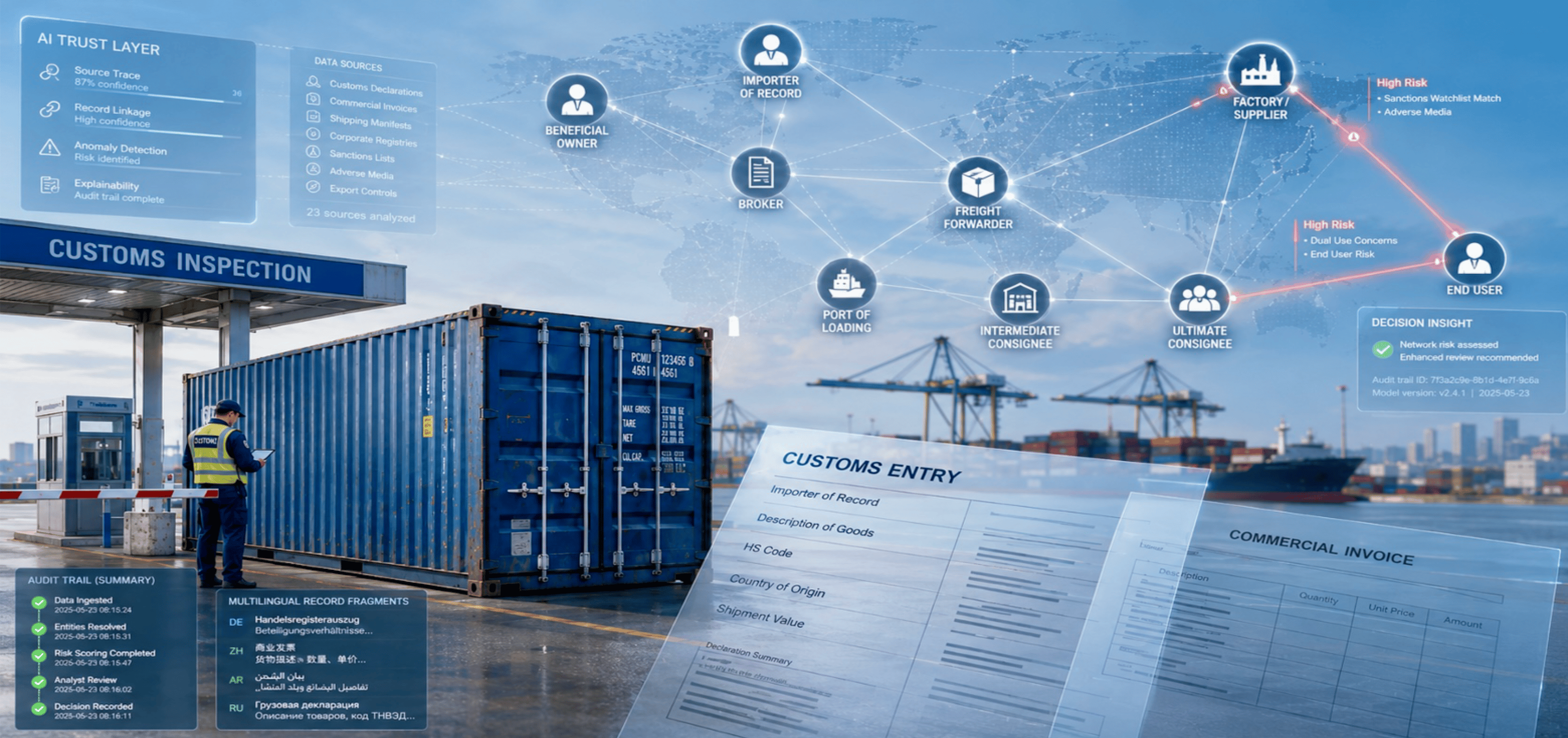
The Network Behind the Transaction

​

This is why the impact of these Executive Orders should be evaluated together. The AI order says trusted technology is now part of the national security conversation. The customs order shows one place where that technology needs to be applied: the network behind the movement of goods.

​

Customs enforcement is no longer limited to comparing a written statement, or its digital equivalent, to what is in the box. The government is moving toward network accountability. It is asking harder questions about importers, owners, affiliates, brokers, forwarders, manufacturers, intermediate and ultimate consignees, production methods, foreign records, and compliance history. For companies, those same questions should appear before the government ever gets involved.

Do we know who we are buying from? Do we know who we are selling to? Do we understand the role of the broker, distributor, freight forwarder, factory, foreign affiliate, intermediate consignee, or ultimate consignee? Does the supplier’s story hold up beyond an email, a quickly built website, or the claim that “ours carries the lowest acceptable bid”? Does the network support the decision we are about to make?

​

These questions sit on both sides of the enforcement line. A company that truly wants to understand what sits behind a customer name, invoice, supplier profile, email address, or country-of-origin claim can use better intelligence to make more selective sales, sourcing, export, and onboarding decisions. On the government side, better visibility can improve targeting, inspections, detentions, seizures, investigative referrals, and coordination across CBP, Homeland Security Investigations (HSI), the Department of Commerce’s Bureau of Industry and Security (BIS), the Department of Justice (DOJ), agency Offices of Inspector General (OIGs), procurement partners, and industry.

​

Different missions require different authorities, but the need is similar: understand the network before the transaction becomes a violation, seizure, penalty, investigation, or the reason a self-disclosure becomes necessary.

​

Customs enforcement does not operate in a vacuum. CBP may see the first physical signal: the shipment, the marking, the country-of-origin claim, the importer, the goods themselves. But the strongest outcomes often come when that customs insight connects to broader investigative work. HSI has long been effective in this space because of its ability to build collaborative relationships across agencies, prosecutors, industry, foreign partners, and the private sector. BIS may see export-control implications. OIGs may see procurement fraud. DOJ may see criminal exposure. Industry may see counterfeit, substandard, or nonconforming goods moving through commercial channels before the government does. What appears at the border is often the first visible edge of a much larger network.

​

Trusted AI Belongs Before the Decision

​

The intersection of these two Executive Orders is practical, not abstract. The AI order reinforces the need for trusted technology where decisions carry national security or critical infrastructure consequences. The customs order shows where that capability can matter operationally: understanding the people, entities, relationships, routes, records, and representations behind the movement of goods.

​

Trusted AI is not a shortcut or an answer machine. It cannot replace the customs broker, investigator, compliance officer, lawyer, procurement official, or executive. The value is in using AI to test the story behind the transaction against the things that often sit outside the file: ownership, affiliates, routing, sourcing, foreign records, local-language material, digital footprints, prior risk indicators, and relationships that do not appear in one system or one document.

​

This is where Tesari AI enters the conversation, not as a customs broker, classification tool, legal-advice engine, or cyber scanner, but as an all-source investigative intelligence platform built for the network behind the decision. In this environment, the issue is not simply whether a party appears on a list or whether a file contains the required paperwork. The issue is whether the people responsible for the decision can understand ownership, control, affiliation, end use, sourcing, routing, foreign records, digital footprints, and signal patterns in time to act.

​

Tesari helps bring those elements into a defensible case file. It applies jurisdiction-specific tradecraft, entity resolution, source provenance, and traceable workflows to the questions these Executive Orders raise: who is behind the transaction, what relationships matter, what records exist outside the file, and whether the network supports the representation being made.

​

For a private company, the questions and implications are plenty: whether to onboard a supplier, approve a sale, hold a shipment, retain a broker, trust an origin claim, continue using a forwarder, accept a customer’s stated end use, or escalate a transaction for legal review. For a government user, the question may be whether a shipment, importer, address, broker, manufacturer, route, intermediate consignee, ultimate consignee, or stated end user deserves closer attention. For both, the work begins before the final decision. It begins with understanding whether the story being presented is supported by the world outside the document.

​

The Responsibility Is Expanding

​

Together, the two Executive Orders point toward a future that is already here. The future of compliance and enforcement will not be built only on better forms, better dashboards, or better screening. Those tools matter, but they are not enough by themselves.

​

The future will depend on whether decision-makers can see the network early enough to act. Screening still matters, but it is only one step in a much larger responsibility. That means importers looking beyond the invoice, exporters testing the stated end user, brokers and forwarders knowing more than the party in front of them, procurement teams questioning the vendor profile, investigators seeing beyond the entry record, and executives refusing to treat a complete file as a complete answer.

​

This is the responsibility Tesari is built to support: helping the people responsible for the decision test the network, understand the activity behind the transaction, and preserve the facts that explain the decision. A file can contain the required documents and still fail to answer the questions that matter most: who is behind the transaction, whether the stated parties are the real parties, whether the claimed origin matches the activity, and whether the surrounding network supports the decision.

​

Tesari helps test the file against the network, so the people responsible for the decision can see whether the record is complete only on paper or complete enough to act. The next standard will not be set by organizations that simply collect more documents or run another screen. It will be set by those that can test the transaction, understand the network, and explain the decision before someone else defines the facts for them.

​

That is the work trusted AI should support. That is the intelligence layer Tesari is built to provide.

​

Authored by Brian Andersen - VP of National Security Applications at Tesari | Former HSI Supervisory Special Agent and Section Chief.

Product

Linkedin

Substack

Tesari Council

Partners

support@tesari.ai

© 2026 All rights reserved

Privacy Statement

Terms of Use

Security Policy

Apply for a Demo

Community Impact

News

Testimonials

TESARI INC

Texas, United States

ic_menu

Brian Andersen

•

June 8, 2026

The Entry Is Where the Goods Appear. The Network Is Where the Risk Lives.

Two Orders, One Direction

​

Two recent Executive Orders point in the same direction. The first, Promoting Advanced Artificial Intelligence Innovation and Security, issued on June 2, 2026, focuses on advanced artificial intelligence, national security, cyber defense, critical infrastructure, frontier-model deployment, and criminal misuse of AI. The second, Strengthening Customs Enforcement, issued on June 3, 2026, focuses on Importers of Record (IORs), with particular attention to foreign IORs, beneficial ownership, affiliates, brokers, freight forwarders, import disclosure and certification requirements, including supply-chain and production-method information, forced labor, misclassification, undervaluation, and illegal transshipment.

​

They are different orders aimed at different problems, but they operate in the same environment. Both recognize that government and industry need to see more, earlier, and understand the people, companies, routes, records, and relationships behind critical decisions. The AI order speaks to the trusted technology side of that environment. It reflects a world where AI is no longer treated only as a productivity tool, but as part of national security, critical infrastructure protection, cyber defense, and preparation for adversarial misuse.

​

The customs order speaks to the enforcement side. Since July 31, 1789, customs officers have stood at one of the federal government’s oldest enforcement front lines, focused on what enters the country: what the goods are, where they came from, what they are worth, who imported them, whether duties were paid, and whether the goods were lawful. Those questions still matter, but the customs order makes clear that the government is looking beyond the face of the transaction. Increasingly, and appropriately, the government needs to know who is behind the importer, who owns or controls the entity, what affiliates sit around it, who moved the goods, who made them, and whether the broader supply chain supports the story being presented. Frankly, so should the compliance department.

When the File Looks Complete

​

The invoice may exist. The country-of-origin claim may rest on little more than the information placed in Box 15 of the U.S. Customs and Border Protection (CBP) Form 7501 entry summary. The supplier profile may appear complete. The importer may have a name, an address, and a broker. The certificate may look clean. That is often enough to move a transaction forward. It is not always enough to understand the risk.

A complete file can still leave unanswered questions about who made the goods, who handled them, who owns or controls the parties, where the goods actually moved, and whether the stated end user or country of origin matches the activity behind the transaction. Complete paperwork is not the same as complete understanding.

I saw this pattern repeatedly in export-control and government supply chain investigations. On the export side, the stated end user was often not the true end user. The listed party could be a shell company, broker, distributor, reseller, research institution, or one of several pass-throughs. In China and Russia matters, research institutions could appear academic or benign on paper while the technology, funding, personnel, or program relationships pointed to military or state-directed work.

​

On the import side, the same visibility problem showed up through origin and sourcing claims. Goods made in China were routed toward U.S. contractors where the Trade Agreements Act (TAA), Buy American, or contract requirements mattered. In some cases, inspection showed goods marked “Made in America” even though they arrived from China or a transshipment country.

​

Those are not the same fact patterns, but they reflect the same problem: the transaction as represented did not match the network or activity behind it. In many investigations, the relationship picture became clear only after subpoenas, summonses, search warrants, inspections, seizures, or interviews. Shell companies, brokers, distributors, freight forwarders, common addresses, shared owners, family members, state-linked entities, hidden manufacturers, and pass-through parties surfaced eventually. But “eventually” is often too late. By then, the export has moved, the goods have entered, the contract has been performed, and companies may have made decisions with far-reaching implications without enough facts to support them.

​

The Network Behind the Transaction

​

This is why the impact of these Executive Orders should be evaluated together. The AI order says trusted technology is now part of the national security conversation. The customs order shows one place where that technology needs to be applied: the network behind the movement of goods.

​

Customs enforcement is no longer limited to comparing a written statement, or its digital equivalent, to what is in the box. The government is moving toward network accountability. It is asking harder questions about importers, owners, affiliates, brokers, forwarders, manufacturers, intermediate and ultimate consignees, production methods, foreign records, and compliance history. For companies, those same questions should appear before the government ever gets involved.

Do we know who we are buying from? Do we know who we are selling to? Do we understand the role of the broker, distributor, freight forwarder, factory, foreign affiliate, intermediate consignee, or ultimate consignee? Does the supplier’s story hold up beyond an email, a quickly built website, or the claim that “ours carries the lowest acceptable bid”? Does the network support the decision we are about to make?

​

These questions sit on both sides of the enforcement line. A company that truly wants to understand what sits behind a customer name, invoice, supplier profile, email address, or country-of-origin claim can use better intelligence to make more selective sales, sourcing, export, and onboarding decisions. On the government side, better visibility can improve targeting, inspections, detentions, seizures, investigative referrals, and coordination across CBP, Homeland Security Investigations (HSI), the Department of Commerce’s Bureau of Industry and Security (BIS), the Department of Justice (DOJ), agency Offices of Inspector General (OIGs), procurement partners, and industry.

​

Different missions require different authorities, but the need is similar: understand the network before the transaction becomes a violation, seizure, penalty, investigation, or the reason a self-disclosure becomes necessary.

​

Customs enforcement does not operate in a vacuum. CBP may see the first physical signal: the shipment, the marking, the country-of-origin claim, the importer, the goods themselves. But the strongest outcomes often come when that customs insight connects to broader investigative work. HSI has long been effective in this space because of its ability to build collaborative relationships across agencies, prosecutors, industry, foreign partners, and the private sector. BIS may see export-control implications. OIGs may see procurement fraud. DOJ may see criminal exposure. Industry may see counterfeit, substandard, or nonconforming goods moving through commercial channels before the government does. What appears at the border is often the first visible edge of a much larger network.

​

Trusted AI Belongs Before the Decision

​

The intersection of these two Executive Orders is practical, not abstract. The AI order reinforces the need for trusted technology where decisions carry national security or critical infrastructure consequences. The customs order shows where that capability can matter operationally: understanding the people, entities, relationships, routes, records, and representations behind the movement of goods.

​

Trusted AI is not a shortcut or an answer machine. It cannot replace the customs broker, investigator, compliance officer, lawyer, procurement official, or executive. The value is in using AI to test the story behind the transaction against the things that often sit outside the file: ownership, affiliates, routing, sourcing, foreign records, local-language material, digital footprints, prior risk indicators, and relationships that do not appear in one system or one document.

​

This is where Tesari AI enters the conversation, not as a customs broker, classification tool, legal-advice engine, or cyber scanner, but as an all-source investigative intelligence platform built for the network behind the decision. In this environment, the issue is not simply whether a party appears on a list or whether a file contains the required paperwork. The issue is whether the people responsible for the decision can understand ownership, control, affiliation, end use, sourcing, routing, foreign records, digital footprints, and signal patterns in time to act.

​

Tesari helps bring those elements into a defensible case file. It applies jurisdiction-specific tradecraft, entity resolution, source provenance, and traceable workflows to the questions these Executive Orders raise: who is behind the transaction, what relationships matter, what records exist outside the file, and whether the network supports the representation being made.

​

For a private company, the questions and implications are plenty: whether to onboard a supplier, approve a sale, hold a shipment, retain a broker, trust an origin claim, continue using a forwarder, accept a customer’s stated end use, or escalate a transaction for legal review. For a government user, the question may be whether a shipment, importer, address, broker, manufacturer, route, intermediate consignee, ultimate consignee, or stated end user deserves closer attention. For both, the work begins before the final decision. It begins with understanding whether the story being presented is supported by the world outside the document.

​

The Responsibility Is Expanding

​

Together, the two Executive Orders point toward a future that is already here. The future of compliance and enforcement will not be built only on better forms, better dashboards, or better screening. Those tools matter, but they are not enough by themselves.

​

The future will depend on whether decision-makers can see the network early enough to act. Screening still matters, but it is only one step in a much larger responsibility. That means importers looking beyond the invoice, exporters testing the stated end user, brokers and forwarders knowing more than the party in front of them, procurement teams questioning the vendor profile, investigators seeing beyond the entry record, and executives refusing to treat a complete file as a complete answer.

​

This is the responsibility Tesari is built to support: helping the people responsible for the decision test the network, understand the activity behind the transaction, and preserve the facts that explain the decision. A file can contain the required documents and still fail to answer the questions that matter most: who is behind the transaction, whether the stated parties are the real parties, whether the claimed origin matches the activity, and whether the surrounding network supports the decision.

​

Tesari helps test the file against the network, so the people responsible for the decision can see whether the record is complete only on paper or complete enough to act. The next standard will not be set by organizations that simply collect more documents or run another screen. It will be set by those that can test the transaction, understand the network, and explain the decision before someone else defines the facts for them.

​

That is the work trusted AI should support. That is the intelligence layer Tesari is built to provide.

​

Authored by Brian Andersen - VP of National Security Applications at Tesari | Former HSI Supervisory Special Agent and Section Chief.

Product

Linkedin

Substack

Tesari Council

Partners

support@tesari.ai

© 2026 All rights reserved

Privacy Statement

Terms of Use

Security Policy

Apply for a Demo

Community Impact

News

Testimonials

TESARI INC

Texas, United States

ic_menu

Brian Andersen

•

June 8, 2026

The Entry Is Where the Goods Appear. The Network Is Where the Risk Lives.

Two Orders, One Direction

​

Two recent Executive Orders point in the same direction. The first, Promoting Advanced Artificial Intelligence Innovation and Security, issued on June 2, 2026, focuses on advanced artificial intelligence, national security, cyber defense, critical infrastructure, frontier-model deployment, and criminal misuse of AI. The second, Strengthening Customs Enforcement, issued on June 3, 2026, focuses on Importers of Record (IORs), with particular attention to foreign IORs, beneficial ownership, affiliates, brokers, freight forwarders, import disclosure and certification requirements, including supply-chain and production-method information, forced labor, misclassification, undervaluation, and illegal transshipment.

​

They are different orders aimed at different problems, but they operate in the same environment. Both recognize that government and industry need to see more, earlier, and understand the people, companies, routes, records, and relationships behind critical decisions. The AI order speaks to the trusted technology side of that environment. It reflects a world where AI is no longer treated only as a productivity tool, but as part of national security, critical infrastructure protection, cyber defense, and preparation for adversarial misuse.

​

The customs order speaks to the enforcement side. Since July 31, 1789, customs officers have stood at one of the federal government’s oldest enforcement front lines, focused on what enters the country: what the goods are, where they came from, what they are worth, who imported them, whether duties were paid, and whether the goods were lawful. Those questions still matter, but the customs order makes clear that the government is looking beyond the face of the transaction. Increasingly, and appropriately, the government needs to know who is behind the importer, who owns or controls the entity, what affiliates sit around it, who moved the goods, who made them, and whether the broader supply chain supports the story being presented. Frankly, so should the compliance department.

When the File Looks Complete

​

The invoice may exist. The country-of-origin claim may rest on little more than the information placed in Box 15 of the U.S. Customs and Border Protection (CBP) Form 7501 entry summary. The supplier profile may appear complete. The importer may have a name, an address, and a broker. The certificate may look clean. That is often enough to move a transaction forward. It is not always enough to understand the risk.

A complete file can still leave unanswered questions about who made the goods, who handled them, who owns or controls the parties, where the goods actually moved, and whether the stated end user or country of origin matches the activity behind the transaction. Complete paperwork is not the same as complete understanding.

I saw this pattern repeatedly in export-control and government supply chain investigations. On the export side, the stated end user was often not the true end user. The listed party could be a shell company, broker, distributor, reseller, research institution, or one of several pass-throughs. In China and Russia matters, research institutions could appear academic or benign on paper while the technology, funding, personnel, or program relationships pointed to military or state-directed work.

​

On the import side, the same visibility problem showed up through origin and sourcing claims. Goods made in China were routed toward U.S. contractors where the Trade Agreements Act (TAA), Buy American, or contract requirements mattered. In some cases, inspection showed goods marked “Made in America” even though they arrived from China or a transshipment country.

​

Those are not the same fact patterns, but they reflect the same problem: the transaction as represented did not match the network or activity behind it. In many investigations, the relationship picture became clear only after subpoenas, summonses, search warrants, inspections, seizures, or interviews. Shell companies, brokers, distributors, freight forwarders, common addresses, shared owners, family members, state-linked entities, hidden manufacturers, and pass-through parties surfaced eventually. But “eventually” is often too late. By then, the export has moved, the goods have entered, the contract has been performed, and companies may have made decisions with far-reaching implications without enough facts to support them.

​

The Network Behind the Transaction

​

This is why the impact of these Executive Orders should be evaluated together. The AI order says trusted technology is now part of the national security conversation. The customs order shows one place where that technology needs to be applied: the network behind the movement of goods.

​

Customs enforcement is no longer limited to comparing a written statement, or its digital equivalent, to what is in the box. The government is moving toward network accountability. It is asking harder questions about importers, owners, affiliates, brokers, forwarders, manufacturers, intermediate and ultimate consignees, production methods, foreign records, and compliance history. For companies, those same questions should appear before the government ever gets involved.

Do we know who we are buying from? Do we know who we are selling to? Do we understand the role of the broker, distributor, freight forwarder, factory, foreign affiliate, intermediate consignee, or ultimate consignee? Does the supplier’s story hold up beyond an email, a quickly built website, or the claim that “ours carries the lowest acceptable bid”? Does the network support the decision we are about to make?

​

These questions sit on both sides of the enforcement line. A company that truly wants to understand what sits behind a customer name, invoice, supplier profile, email address, or country-of-origin claim can use better intelligence to make more selective sales, sourcing, export, and onboarding decisions. On the government side, better visibility can improve targeting, inspections, detentions, seizures, investigative referrals, and coordination across CBP, Homeland Security Investigations (HSI), the Department of Commerce’s Bureau of Industry and Security (BIS), the Department of Justice (DOJ), agency Offices of Inspector General (OIGs), procurement partners, and industry.

​

Different missions require different authorities, but the need is similar: understand the network before the transaction becomes a violation, seizure, penalty, investigation, or the reason a self-disclosure becomes necessary.

​

Customs enforcement does not operate in a vacuum. CBP may see the first physical signal: the shipment, the marking, the country-of-origin claim, the importer, the goods themselves. But the strongest outcomes often come when that customs insight connects to broader investigative work. HSI has long been effective in this space because of its ability to build collaborative relationships across agencies, prosecutors, industry, foreign partners, and the private sector. BIS may see export-control implications. OIGs may see procurement fraud. DOJ may see criminal exposure. Industry may see counterfeit, substandard, or nonconforming goods moving through commercial channels before the government does. What appears at the border is often the first visible edge of a much larger network.

​

Trusted AI Belongs Before the Decision

​

The intersection of these two Executive Orders is practical, not abstract. The AI order reinforces the need for trusted technology where decisions carry national security or critical infrastructure consequences. The customs order shows where that capability can matter operationally: understanding the people, entities, relationships, routes, records, and representations behind the movement of goods.

​

Trusted AI is not a shortcut or an answer machine. It cannot replace the customs broker, investigator, compliance officer, lawyer, procurement official, or executive. The value is in using AI to test the story behind the transaction against the things that often sit outside the file: ownership, affiliates, routing, sourcing, foreign records, local-language material, digital footprints, prior risk indicators, and relationships that do not appear in one system or one document.

​

This is where Tesari AI enters the conversation, not as a customs broker, classification tool, legal-advice engine, or cyber scanner, but as an all-source investigative intelligence platform built for the network behind the decision. In this environment, the issue is not simply whether a party appears on a list or whether a file contains the required paperwork. The issue is whether the people responsible for the decision can understand ownership, control, affiliation, end use, sourcing, routing, foreign records, digital footprints, and signal patterns in time to act.

​

Tesari helps bring those elements into a defensible case file. It applies jurisdiction-specific tradecraft, entity resolution, source provenance, and traceable workflows to the questions these Executive Orders raise: who is behind the transaction, what relationships matter, what records exist outside the file, and whether the network supports the representation being made.

​

For a private company, the questions and implications are plenty: whether to onboard a supplier, approve a sale, hold a shipment, retain a broker, trust an origin claim, continue using a forwarder, accept a customer’s stated end use, or escalate a transaction for legal review. For a government user, the question may be whether a shipment, importer, address, broker, manufacturer, route, intermediate consignee, ultimate consignee, or stated end user deserves closer attention. For both, the work begins before the final decision. It begins with understanding whether the story being presented is supported by the world outside the document.

​

The Responsibility Is Expanding

​

Together, the two Executive Orders point toward a future that is already here. The future of compliance and enforcement will not be built only on better forms, better dashboards, or better screening. Those tools matter, but they are not enough by themselves.

​

The future will depend on whether decision-makers can see the network early enough to act. Screening still matters, but it is only one step in a much larger responsibility. That means importers looking beyond the invoice, exporters testing the stated end user, brokers and forwarders knowing more than the party in front of them, procurement teams questioning the vendor profile, investigators seeing beyond the entry record, and executives refusing to treat a complete file as a complete answer.

​

This is the responsibility Tesari is built to support: helping the people responsible for the decision test the network, understand the activity behind the transaction, and preserve the facts that explain the decision. A file can contain the required documents and still fail to answer the questions that matter most: who is behind the transaction, whether the stated parties are the real parties, whether the claimed origin matches the activity, and whether the surrounding network supports the decision.

​

Tesari helps test the file against the network, so the people responsible for the decision can see whether the record is complete only on paper or complete enough to act. The next standard will not be set by organizations that simply collect more documents or run another screen. It will be set by those that can test the transaction, understand the network, and explain the decision before someone else defines the facts for them.

​

That is the work trusted AI should support. That is the intelligence layer Tesari is built to provide.

​

Authored by Brian Andersen - VP of National Security Applications at Tesari | Former HSI Supervisory Special Agent and Section Chief.

Product

Privacy Statement

Terms of Use

Security Policy

Linkedin

Substack

Tesari Council

Newsroom

Partners

Community Impact

Community Impact

Apply for a Demo

© 2026 All rights reserved

support@tesari.ai

Testimonials

TESARI INC

Texas, United States

​

Log in

Apply for a Demo